Battle damage repair.
Spare parts on demand.
Wherever your mission is.
A broken part at a forward operating base, on a ship in the Pacific, or in a depot the OEM left 20 years ago. The replacement now sits in a container somewhere overseas, the ticket runs six weeks. Wire-Laser Metal Deposition changes that: a Meltio M600 — or a deployed version in a container — produces the part on the spot in hours, not weeks. The same technology already used by US Navy, Spanish Air Force, and Korean Marine Corps. We sell and integrate the printers with Defense organisations and their suppliers in BENELUX.
"If the crew had to rely on a replacement part without using additive manufacturing, it would have taken weeks or months. With this technology, we'll have the new component printed and ready for installation before the order for a replacement would be completed."
— Staff Sgt. Jordan Blake, US Marine Innovation Unit

Three problems that undermine operational readiness
No abstract supply-chain talk. Three pain points operators, MROs and logistics commands face every day — and that Wire-LMD makes solvable on the spot.
Global supply chains disrupted, lead times unpredictable
A spare part for a frigate, combat vehicle or helicopter comes from an OEM chain that geopolitics, sanctions or capacity no longer delivers in days. 6-12 weeks lead time is normal, and pricing is volatile. For mission-critical platforms, that's a readiness risk growing every quarter.
Legacy platforms, OEM gone
Ships, vehicles and weapon systems run for decades. The original supplier has been acquired, merged or bankrupt. CAD files are gone, moulds scrapped, parameters in a 1998 TIFF archive. Reverse-engineering to a foundry for one piece is rarely viable — and gives the same long wait.
Logistical burden of thousands of spare parts
A forward operating base or naval vessel has to stock hundreds to thousands of spare parts, 'just in case'. Containers full of parts, fuel and cargo space that could carry something more useful. A Wire-LMD printer plus a spool of wire replaces half that inventory — just-in-time printed when there is demand.
Six pain points, six comparisons
Per pain point: left what the current supply chain delivers, right what changes the moment a Meltio system stands on your location — depot, ship, or forward operating base.
Spare parts lead time
Spare part for a ship or vehicle in operation: 6-12 weeks via OEM chain, plus customs, plus logistics to the forward platform.
USS Arleigh Burke eductor (NAVSEA + Spanish Navy): −80% production time. Print and machining straight on board or in nearby MRO facility. No logistics chain to traverse.
Legacy spare parts (OEM gone)
OEM gone or refuses small batches. Reverse-engineering to a foundry: months to a year for one piece. Spanish Army quote: 'obsolescence is one of the largest readiness blockers'.
3D scan + Wire-LMD print = legacy spare in hours to days. Korean Marine Corps already uses it: 'It has become possible to quickly manufacture repair parts that are discontinued or difficult to procure.'
Battle damage repair
Damaged part = platform out of service. Replacement from depot (if available) or new from OEM (weeks). Whole platform unavailable during the wait.
Spanish Air Force case (jet engine): repair of high-value parts in titanium and copper-alloys, on the spot. Wire-LMD does cladding and repair, not just new production — damaged geometry restored part-by-part.
Lightweight components
Parts like tank ice cleats: solid metal blocks (10.74 kg each). Soldiers must manually mount 30-50 per tank — high physical load, time expensive under operational pressure.
K2 Black Panther case: honeycomb redesign via AM brought weight down to 4.26 kg — 60% lighter with mechanical properties intact. Bonus: ~0.64% fuel efficiency improvement, three pads at once per print cycle.
Logistical footprint
Hundreds to thousands of spare parts in stock. Containers full of parts, freight and storage costs at every step in the chain — depot, transport, forward base, ship.
One printer plus a spool of wire = hundreds of spare-part designs. Spool fits in a cabinet. Demand-driven production replaces inventory. Containerized solutions (like Korean Marine 'Holonic') bring the printer to the operation.
Material flexibility
Each part type its own supplier, own material chain, own lead time. SS part here, titanium there, copper-alloy somewhere else — three different chain dependencies.
One Meltio M600 prints SS316L, Titanium Ti6Al4V, Marine Bronze, Inconel 718 — just swap the wire spool. Spanish Air Force uses it for both titanium and copper-alloys on one machine.
AM doesn't fully replace the logistics chain. For mission-critical platforms, a validated OEM chain remains needed on critical components. What changes: where the chain breaks — obsolete parts, battle damage, urgent maintenance — you now have an alternative that works in hours instead of weeks.
From depot workshop to deployable container
Same Meltio Wire-LMD technology, three configurations. Which fits depends on where you produce: in an MRO facility, in a mobile workshop, or integrated on an existing CNC installation.
DoD proved it: deployable hybrid manufacturing
Phillips Corporation installed the first hybrid Meltio machine in a deployable shipping container at Rock Island Arsenal in 2021. US Army xTech-program 5th place for the Meltio Engine system with nitrogen-generated inert gas — works anywhere nitrogen generators can run.
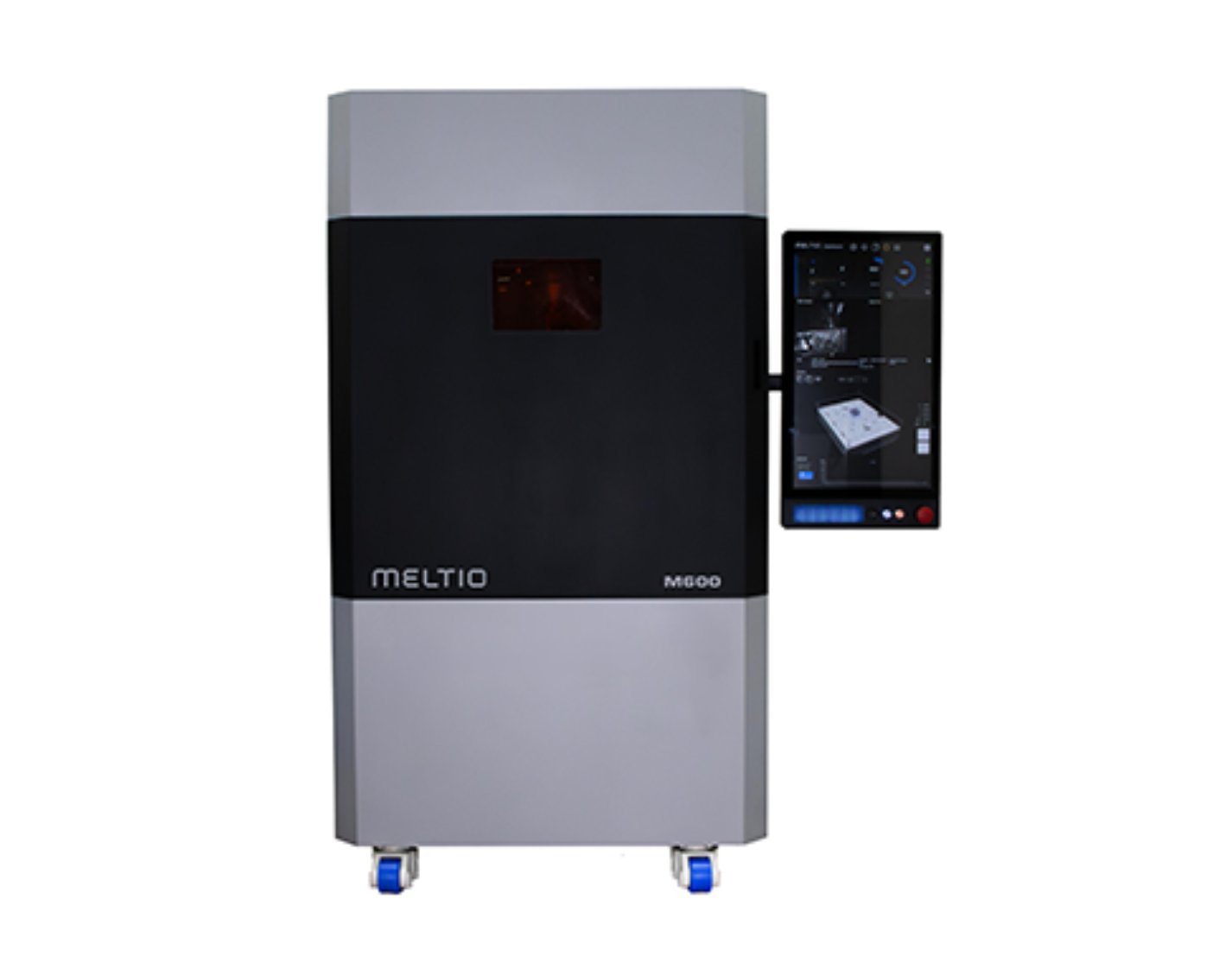
Meltio M600
Standalone Wire-LMD printer for MRO facilities, depot workshops, and base workshops. Inert chamber, blue laser, 24/7 unattended. Build envelope 300 × 400 × 600 mm, parts up to 100+ kg. The printer AM Solutions used to produce the K2 Black Panther snow pads for Korean Marine Corps.

Meltio Engine CNC Integration kit
Retrofit kit that turns a CNC into a hybrid machine: print and mill in one setup, one G-code. The configuration DoD deploys in deployable containers (Rock Island Arsenal, USS Bataan). Process-inert gas via nitrogen generators — no external argon chain needed. Fits your existing VMCs in workshops or in shipping containers.
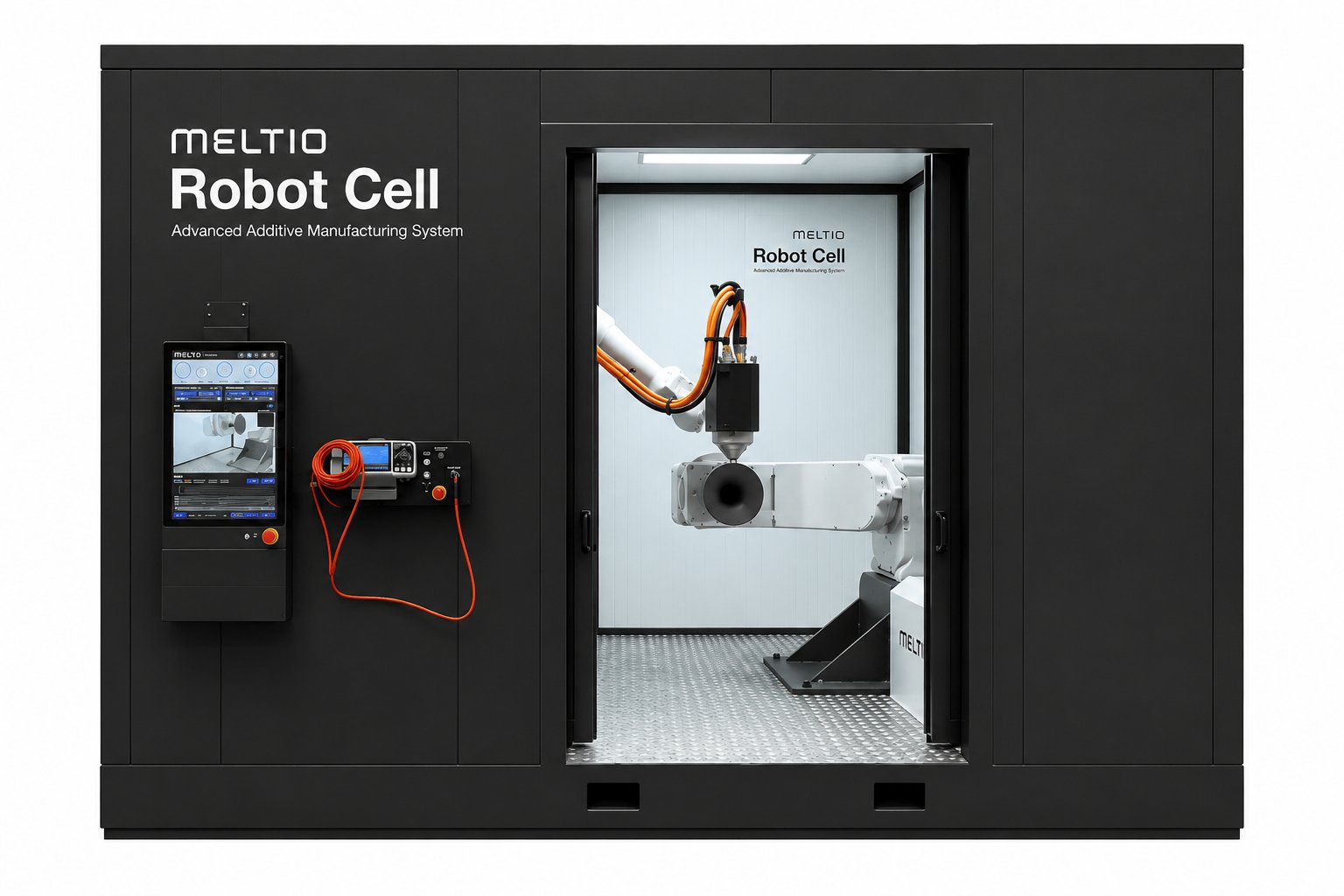
Meltio Robot Cell
8-axis turn-key production cell with robot + positioner + laser-safe enclosure. Build envelope up to 2000 × 1000 × 1000 mm, parts up to ~400 kg. For large defense components — vehicle structures, marine pump housings, artillery components — too big for an M600 or standard VMC.
Which configuration fits depends on: where you produce (depot vs operational platform), which geometry, which material, and whether you work standalone or integrated with existing CNC. We advise based on your use case, deliver, install and train your operators. For classified projects we arrange NDA before sharing technical detail.
Four real defense use cases on Meltio Wire-LMD
What the Meltio M600 already produces for defense organisations worldwide — published by Meltio and confirmed by the relevant units. With source link per case.
Korean Marine Corps · K2 Black Panther snow pads
AM Solutions (Meltio's South Korean partner) developed via Wire-LMD on M600 a redesign of the ice cleats for the K2 Black Panther tank. Honeycomb structure optimised for AM brought weight from 10.74 kg to 4.26 kg per piece — a 60% reduction with all mechanical properties preserved. 30-50 pieces per tank means significant physical relief for soldiers plus ~0.64% fuel efficiency. Three pads at once per print cycle.

USS Arleigh Burke · eductor on-board repair
FDRMC Rota and Spanish Navy produced via Wire-LMD an eductor for the USS Arleigh Burke — a US destroyer in operation. NAVSEA accelerated AM part approval for low-risk components and the approach saved more than 80% of typical production time. Rear Adm. Pete Small (NAVSEA chief engineer) confirmed the project proved how AM generates readiness by restoring critical systems within the compressed timeline of a forward-deployed patrol.

Spanish Air Force · jet engine repair
The Spanish Air Force uses Meltio Wire-LMD for repair of high-value parts in jet engines. Not production but cladding/repair: locally adding material on damaged geometry, then machining to final tolerance. Works with titanium and copper-based alloys on one and the same machine — no swap cycle needed between materials. One of the first defense organisations to deploy Wire-LMD operationally for maintenance.

Spanish Army · armored vehicle spare parts
The Spanish Defense Department deploys Meltio Wire-LMD to produce spare parts for armored vehicles whose OEM chain no longer supplies. Containerized AM installation, SS316L. Quote: 'these joint actions improve supply and logistics chains, increase operability of fleets and resources in operations, and avoid problems related to obsolescence.' Concrete answer to the 25-year-old-platform problem.
Critical parts, printed locally.
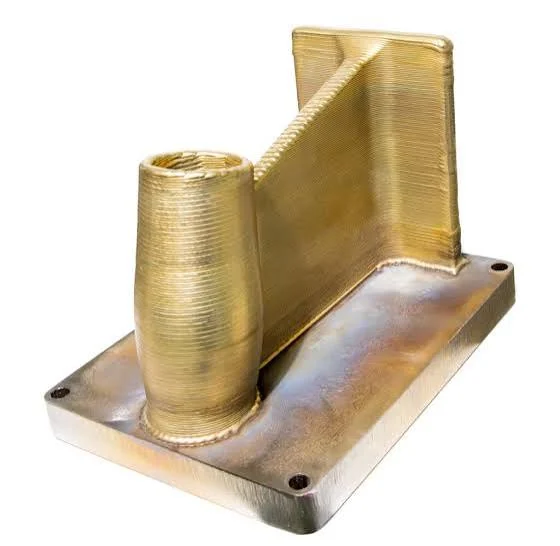 Engine part in marine bronze
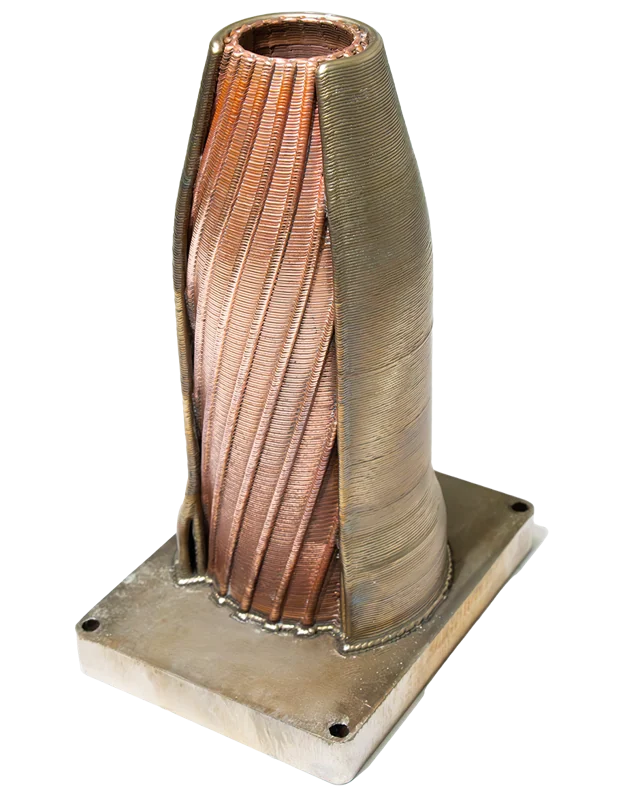 Rocket nozzle in titanium and copper
From briefing to production-ready printer
The cycle for bringing Meltio Wire-LMD in-house via 3DPS. For defense organisations with procurement requirements and classified context: under NDA where needed, respecting your purchase process and compliance requirements.
-
01
Technical briefing + use-case discussion
You tell us about your application — which platform, which parts, which materials, which deployment context (depot, ship, forward base). Under NDA where classification requires. We pair that with a logical configuration and organise a live demo at a reference installation or with us.
-
02
Configuration advice + DfAM training
We compose the printer configuration that fits your use case: standalone M600 for an MRO workshop, Engine CNC retrofit on an existing hybrid machine, or a containerized deployable solution. Including DfAM session for your engineering team — so your people know which designs matter in defense context.
-
03
Procurement track + delivery
We guide the procurement process through your defense purchasing chain. Delivery to your location, installation, connections (electrical, inert gas via argon or nitrogen generators for deployable setups), commissioning and factory-acceptance prints on your geometry.
-
04
Operator training and parameter handover
Your operators (military or civilian personnel) trained on slicer software (Meltio Horizon / Space), machine use, material change and process monitoring. You receive validated print-parameter sets for the materials you purchase. From that moment your unit produces independently.
-
05
Maintenance, supply and ongoing support
Service contract for maintenance, calibration and spares. Wire we supply onwards — qualified for your print-parameter sets. Ongoing technical support for new parts, materials or platforms you add. For classified projects: NDA stays in force.
From then on the machine runs under your own flag — you decide what, when, and for which platform you produce.
Four alloys for defense applications
Materials qualified on Meltio Wire-LMD for defense. Other alloys possible on request — parameter validation typically takes a few weeks.
These printers work within your compliance framework
Defense applications operate under strict requirements: NATO STANAG material specifications, AS9100 (defense-aerospace), MIL-spec testing on critical components, ITAR/EAR controls on sensitive technology. Meltio M600 produces in an inert chamber with <10 ppm oxygen, with material certificates, print-parameter logs and process data standard in the output. NAVSEA has accelerated AM part approval for low-risk components on the USS Arleigh Burke case. US Army xTech-program recognised the technology as deployable-ready. What you get: machines your own quality organisation can calibrate and certify within your existing QA chain and procurement process. We transfer that capability at installation, along with training modules to let your operators work independently — civilian and military personnel.
Book a technical briefing for your unit
Book a briefing or demo, or send us a use case to check whether Wire-LMD solves it. Under NDA where needed. A free feasibility analysis tells you which configuration fits, which material, and what the impact is on your readiness and logistical footprint.